CDP vs. CRM vs. Marketing Data Platform: Which Layer Does What
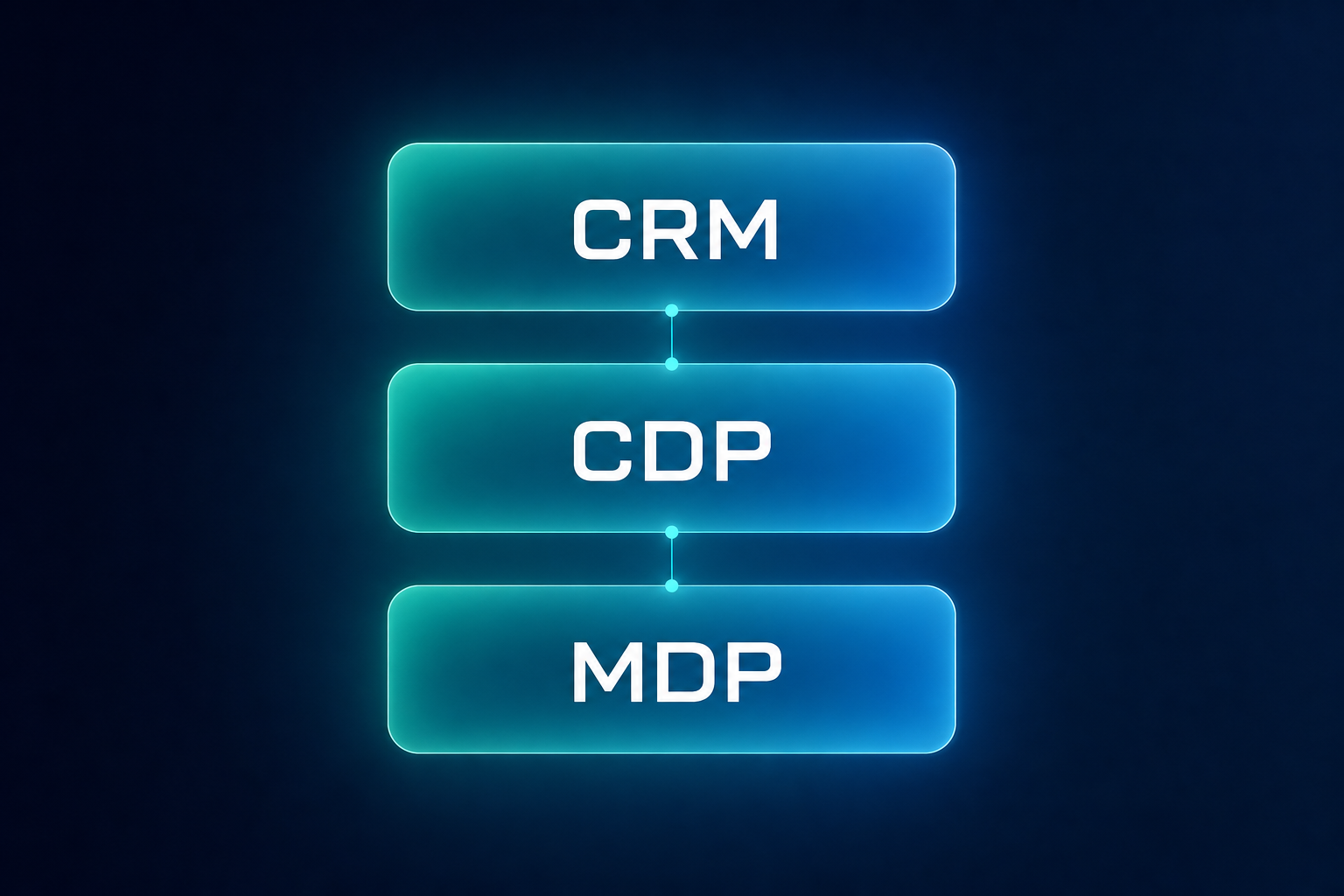
Marketing teams often frame the choice between a CDP (Customer Data Platform), a CRM (Customer Relationship Management), and a Marketing Data Platform as a single purchase decision. It is not. These are three layers with three different jobs. Most teams already run one or two of them, then buy a third tool instead of filling the actual gap.
This article maps what each layer does, what it does not do, and how to tell which one is missing from a stack.
The common problem
The pattern repeats across mid-market B2B (business-to-business) organizations:
- Sales works in the CRM (Customer Relationship Management).
- Marketing exports GA4 (Google Analytics 4), ad platforms, and CRM data into spreadsheets each week.
- Finance asks which channels drove revenue last year.
- Each team reports a different number, because each uses a different definition.
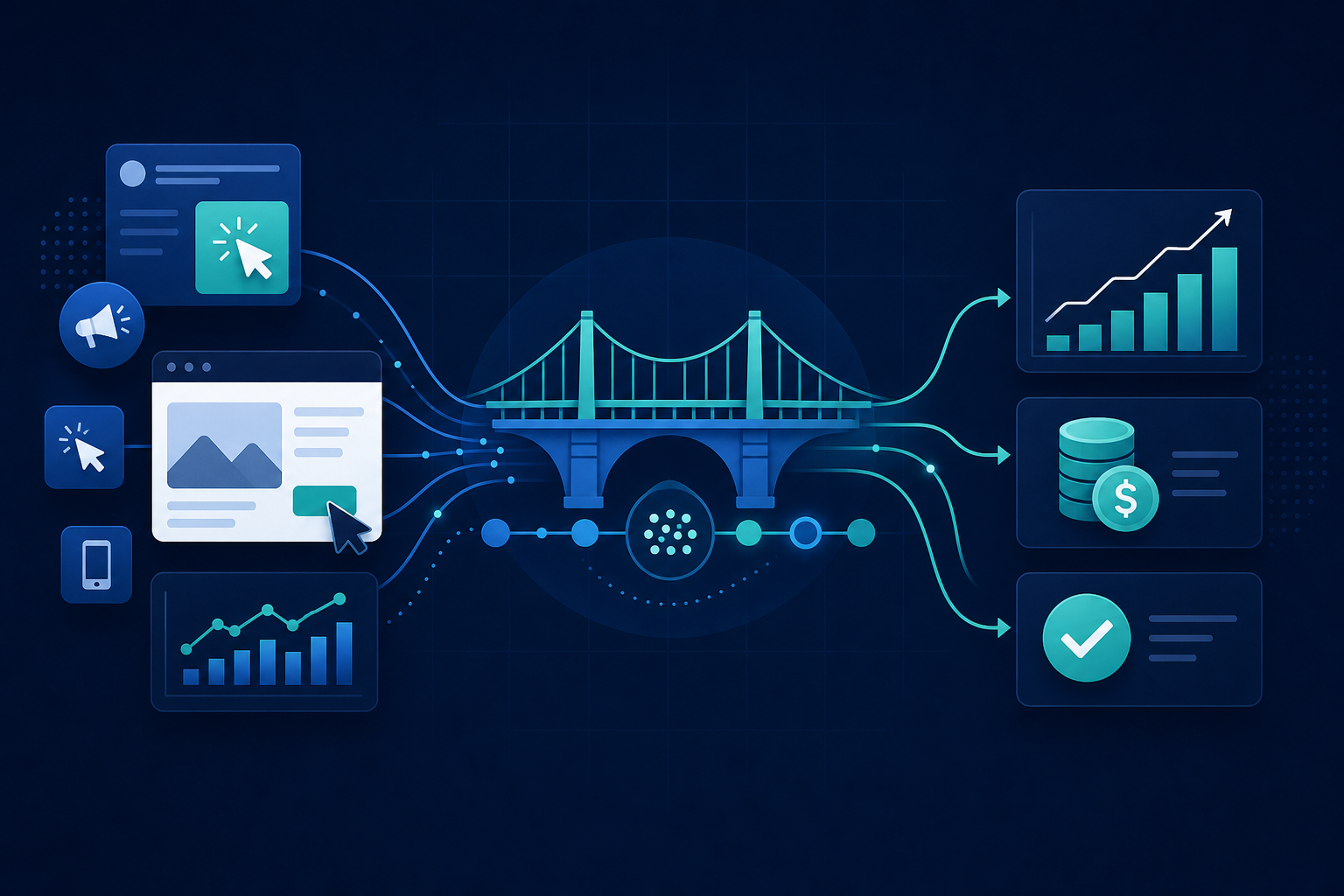
The issue is rarely a missing tool. It is a missing layer that connects marketing activity to revenue with one shared definition.
Compare jobs, not features
The standard advice ("CDP and CRM are complementary, use both") is correct but does not help with a purchase decision. The more useful question is which job needs filling.
No common tool owns marketing performance measurement. A CRM manages workflow. A CDP manages profiles. Neither produces a governed model that ties channel spend to CRM revenue.
The category is also shifting. David Raab, who defined the term Customer Data Platform in 2013, has noted that "composable CDP" is fading as a distinct category: packaged vendors now split into modules, and CRM vendors add AI on CRM data alone. None of that resolves cross-channel comparability.
| CRM | CDP | MDP | |
|---|---|---|---|
| Full name | Customer Relationship Management | Customer Data Platform | Marketing Data Platform |
| Job | Manage relationships | Unify profiles, activate journeys | Measure marketing performance |
| Owns | Deals, tickets, pipeline | Identity, segments, profiles | Channels, campaigns, KPIs (Key Performance Indicators) joined to CRM revenue |
| Does not do | Cross-channel attribution | Budget reporting, channel comparability | Sales workflows, journey orchestration |
| Answers | "What is happening with this account?" | "Who is this person across channels?" | "What revenue did this channel drive?" |
CRM: the system of engagement
A CRM (Customer Relationship Management) is where sales and service teams work: calls, deals, tickets, and follow-ups.
It answers what is happening with a given account. It does not answer what a marketing channel drove in revenue.
A typical limitation:
- An opportunity source is set to "LinkedIn" by a sales rep from a dropdown.
- There is no governed UTM (Urchin Tracking Module) or GCLID (Google Click Identifier) path linking that closed deal to a specific campaign.
- Marketing, sales, and finance each report a different figure.
A CRM remains the right tool for pipeline management, service history, and the marketing-to-sales handoff. It is not a marketing database, even with an analytics add-on. Embedded CRM marketing modules inherit the CRM's limits: manually entered fields, weak anonymous tracking, and no shared taxonomy across GA4 and ad platforms.
In short, a CRM records what the team did and feeds other systems. It is not the source of truth for marketing performance.
CDP: the system of intelligence
David Raab defined a CDP (Customer Data Platform) as packaged software that creates a persistent, unified customer database accessible to other systems.
A CDP answers who a person is across channels and which segment they belong to. Its strengths are identity resolution, linking anonymous and known activity, and pushing real-time segments to ads, email, and marketing automation.
The common mistake is scoping a CDP for a measurement problem. CDP RFPs (Requests for Proposal) tend to center on personalization: segments, journeys, and triggers. That does not answer the budget question most CMOs (Chief Marketing Officers) face: which channels deserve investment next quarter.
A CDP can ingest CRM data and enrich profiles, but profile completeness is not the same as trustworthy marketing KPIs (Key Performance Indicators). Reliable reporting still requires matching channel definitions across GA4 and Google Ads, with revenue joined at conversion rather than at lead creation.
A simple rule:
- If the pain is proving marketing impact, a CDP is not the right starting point.
- If the pain is cross-channel personalization, CDP components fit.
MDP: the system of marketing performance
This is the layer most stacks lack.
A Marketing Data Platform (MDP) unifies and governs marketing data from channels, web, ads, and CRM outcomes. It joins that data at the conversion and revenue level, not at the lead level or via rep-entered source fields.
It answers questions such as:
- Which channels drove revenue?
- Which channels should receive budget next quarter?
- Can finance and marketing agree on CAC (Customer Acquisition Cost) and ROAS (Return on Ad Spend)?
How it differs from adjacent tools:
- Versus a generic data warehouse: a warehouse project can run for a year while marketing still exports to spreadsheets, because the model is not marketing-native.
- Versus a CDP: a CDP activates people; an MDP measures performance.
- Versus a CRM: a CRM runs workflow; an MDP runs measurement.
- Versus connectors (e.g. Supermetrics, Funnel.io): connectors move data but do not provide governed joins to CRM revenue. CKW (AXPO Group) rejected connector-only setups because they needed CRM joins, not another feed marketing could not use.
A typical MDP includes:
- UTM governance across ad accounts
- Click identifier hygiene (GCLID, GBRAID, WBRAID) at the CRM boundary
- A shared asset taxonomy, so a channel name means the same thing everywhere
- CRM joins at revenue events, not form fills
- Offline conversion push to ad platforms when the sale closes in the CRM
The outcomes are measurable. CKW (AXPO Group) consolidated fragmented dashboards into one source of truth, reaching 95% data quality and full campaign attribution. The University of Zurich Executive Education increased tracked customer journeys from near zero to roughly 90% and shifted its KPI focus from raw leads to CAC and ROAS.
How the three layers work together
The layers are complementary, not competing.
A typical data flow:
- Web, ads, and app data feed the MDP (Marketing Data Platform), and optionally a CDP (Customer Data Platform).
- The CRM feeds both, with deals, interactions, and closed-won revenue.
- The MDP supports budget decisions, board reporting, and ad platform activation.
- The CDP supports segments, personalization, and journeys.
- The CRM receives enriched signals and triggers sales tasks.
A practical way to decide what to add, based on the primary decision the tool must support:
- Budget allocation or revenue proof: prioritize the MDP.
- Real-time personalization: scope CDP components, and confirm the result can be measured.
- Sales workflow: optimize the CRM rather than adding a CDP.
- Recurring disputes over definitions: add an MDP before another dashboard.
- A full customer profile for journeys: a CDP fits, provided journeys can be tied to revenue.
The general principle: add the missing layer rather than duplicating an existing one. Most stacks already have a CRM and channel dashboards. The gap is governed click-to-revenue measurement.
Summary
- A CRM (Customer Relationship Management) manages relationships.
- A CDP (Customer Data Platform) unifies profiles for activation.
- An MDP (Marketing Data Platform) measures performance and connects clicks to CRM revenue.
The decision is not about choosing a winner. It is about identifying the missing layer and matching it to the decisions it needs to support. When budget allocation and revenue proof are the priorities, the MDP is usually the gap, not another CDP evaluation.
Dashflow is a Marketing Data Platform built for teams that want to stop reconciling exports: standard pipelines for channels, web, and CRM, with data quality, governance, CRM depth, and activation included.
Free GA4 Review: identifies whether the problem is tracking, governance, or a missing CRM join.
Book a Strategy Call: a 30-minute review to map the missing layer in your marketing stack.
Written by
Dashflow Team